
 See My Latest Article on HelloNation
Can a car dent be repaired without repainting?
Often, yes. Paintless Dent Repair (PDR) may be appropriate when the original paint is still intact and the metal or panel has not been stretched beyond its ability to return to shape.
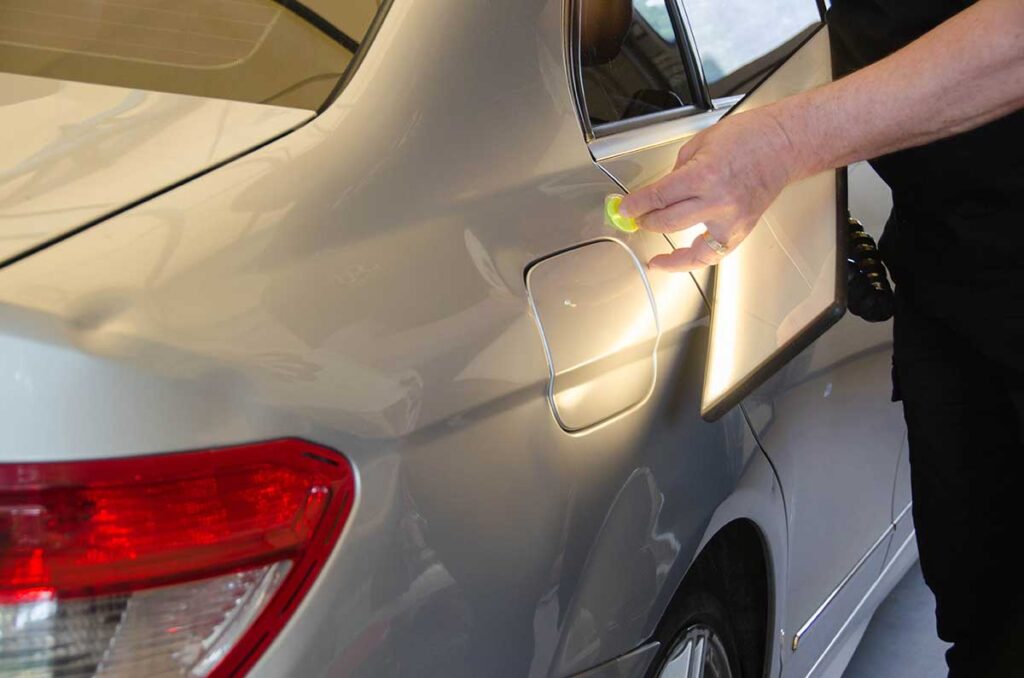
PDR reshapes the damaged panel from behind or, in some cases, from the front using controlled pressure and specialized tools. Because the original finish remains in place, the repair does not require sanding, body filler, primer, or matching replacement paint.
Not every dent qualifies. The most useful clues are the condition of the paint, the depth and location of the damage, the type of panel involved, and whether the metal has sharply folded.
Is the paint still intact?
Intact paint is the first requirement. Look closely at the dent in bright, indirect light and check for:
- Cracks or splits in the paint
- Chipped areas
- Scratches that expose a different color underneath
- Peeling or bubbling
- White, gray, or bare-metal lines along a crease
- Paint transfer from another object
A shallow dent with smooth, unbroken paint is generally more suitable for PDR than a dent with visible paint failure. A small scratch does not always rule out paintless repair, but it may mean that additional cosmetic work is needed after the dent is reshaped.
A useful test is to clean the area gently with soap and water. Dirt and surface marks can make damage appear worse than it is. Avoid using abrasive compounds or aggressive polishing before the damage is assessed, since these can change the appearance of the finish.
Does the dent have soft or sharp edges?
The shape of the dent provides important information. A rounded depression with gradual edges is usually more repairable than a sharp, angular fold.
Soft dents commonly result from:
- A door or shopping cart impact
- A ball or similar object
- A minor parking-lot contact
- Hail or small falling objects
- A low-speed bump
Sharp creases can stretch the metal and create a permanent change in the panel. PDR may still improve some creases, but a sharp fold, especially one with cracked paint, has a lower chance of returning to a completely invisible condition.
The center of the dent matters as well. A smooth, bowl-shaped depression is different from a dent with a narrow ridge running through it. That ridge may represent stretched metal or a concentrated impact point.
Where is the dent located?
Some areas of a vehicle are easier to access and reshape than others. A dent on the broad, open portion of a door, hood, roof, or fender is often more favorable than one located directly on an edge or body line.
Pay particular attention to:
- Door edges and panel corners
- Sharp character lines
- Wheel-arch lips
- Areas near the fuel door
- Sections reinforced by braces
- Places close to hinges, latches, or thick structural supports
A dent crossing a body line can sometimes be repaired, but the work generally requires more precise control. Damage directly on an edge may have stretched or folded the metal, making a fully paint-free result less predictable.
The material also matters. Steel and aluminum behave differently, and some panels have limited access behind them. Plastic bumpers are not repaired through traditional PDR methods in the same way as metal panels, although heat reshaping may be possible for certain bumper dents.
Is the panel metal, aluminum, or plastic?
The panel material affects how the damage responds. Steel is commonly suited to controlled reshaping because it can gradually move back toward its original form. Aluminum can also be repaired without paint, but it may require different techniques because it is less forgiving and may hold a crease differently.
Plastic bumper covers can sometimes be reshaped after a low-speed impact, but their repair process is not the same as PDR for metal. If the bumper is cracked, torn, badly scuffed, or pulled away from its mounting points, reshaping alone will not restore it.
Vehicle construction can also limit access. Interior trim, bracing, insulation, window mechanisms, and airbags may be positioned behind the damaged area. A dent that looks simple from the outside may be difficult to reach safely from the inside.
Has the metal been stretched?
A dent is more likely to be repairable when the panel has been displaced rather than significantly stretched. A displaced panel has moved inward but still retains most of its original shape. A stretched panel has expanded around the impact and may resist returning to a flat surface.
Signs of possible stretching include:
- A raised crown around the dent
- Wavy reflections across the panel
- A very deep center with tight edges
- A sharp impact point
- Several overlapping creases
- A panel that remains loose or distorted after light pressure
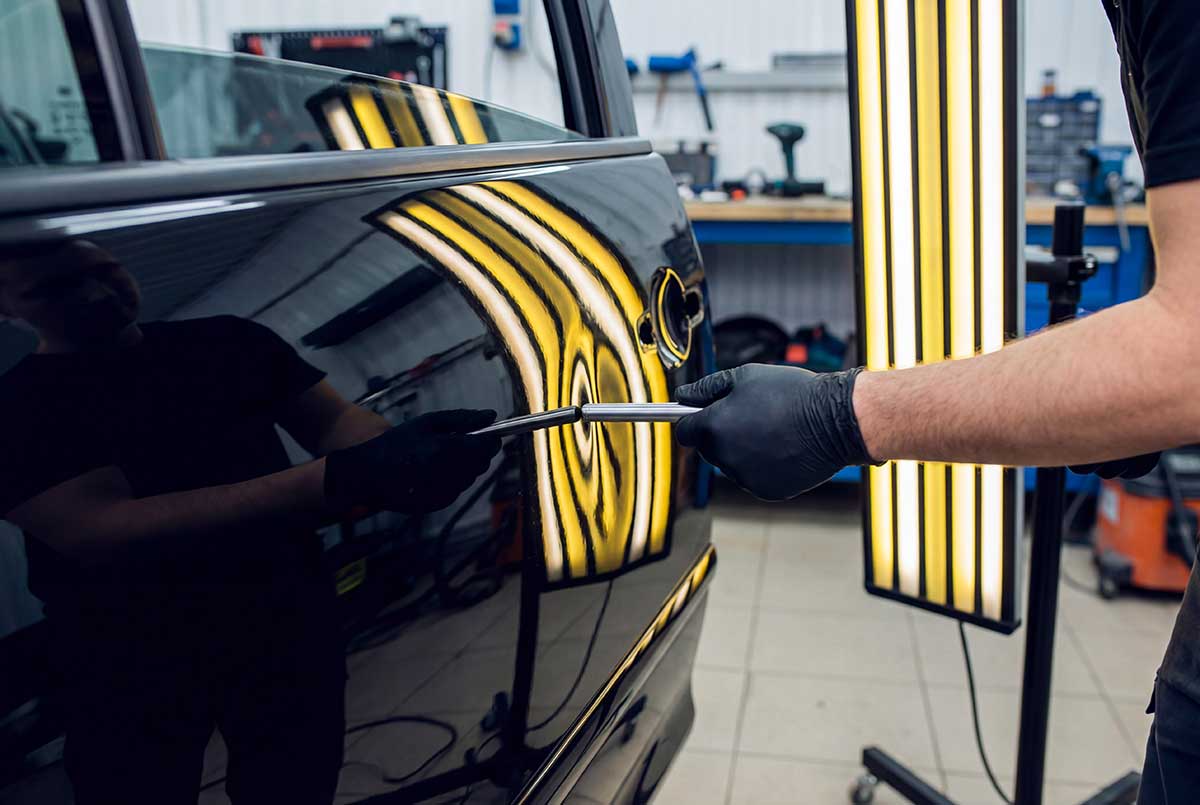
A trained inspection is often needed to distinguish a simple depression from stretched metal. Looking at reflections across the panel can help: place the vehicle where the surface reflects a straight line, such as a building edge or light source. Distorted reflections may reveal subtle high spots or ripples that are difficult to see directly.
How does Florida weather affect the assessment?
Ocala’s warm, humid conditions can influence how a damaged vehicle looks and behaves. Sun-heated panels may appear slightly different from cool panels, and moisture, pollen, road dust, and tree residue can hide fine scratches or make a shallow dent harder to evaluate.
Seasonal storms also create different patterns of damage. Hail dents are often small and rounded, while falling branches or debris may leave sharper creases, chipped paint, or multiple contact points. A vehicle exposed to intense sun may also have older paint that is less flexible or already weakened by fading and oxidation.
Temperature alone does not determine whether PDR is possible, but the panel should be clean and inspected under consistent lighting. A dent that appears minor in shadow may show more damage in direct sunlight or under a controlled reflection.
Can a dent be repaired without paint if the paint is scratched?
Sometimes, but the answer depends on the scratch. PDR can reshape the metal; it cannot replace missing paint or remove every surface defect.
If the scratch is only on the clear coat, polishing may improve its appearance after the dent is corrected. If the scratch reaches the colored paint, primer, or bare metal, a separate refinishing process may be necessary. Bare metal should not be ignored because moisture can eventually lead to corrosion.
Paint transfer from another object may look like chipped paint but can sometimes be cleaned away. This is why the area should be washed carefully before judging the damage.
What dents are poor candidates for paintless repair?
PDR is less likely to produce a fully satisfactory result when:
- The paint is cracked, peeling, or missing
- The dent is located on a sharply folded edge
- The panel has severe creasing or visible stretching
- The metal is torn or punctured
- The bumper or plastic panel is split
- The damage involves a structural part
- The panel has already been heavily filled or repainted
- The dent sits where safe tool access is not available
That does not always mean the vehicle cannot be repaired. It means a conventional body-repair method, part replacement, or a combination of techniques may be more appropriate.
What should a vehicle owner check before deciding?
Take clear photographs from several angles, including a close view and a wider view showing the panel’s position on the vehicle. Wash away dirt and inspect the paint without rubbing aggressively. Check whether doors, windows, the hood, trunk, lights, and body gaps operate normally.
If the impact affects a door latch, hood latch, lighting component, wheel area, sensor, or structural support, the issue is no longer purely cosmetic. Safety-related damage should be evaluated before relying on appearance alone.
The clearest general rule is simple: a shallow or moderate dent with smooth edges, intact paint, and no sign of stretched or torn metal is the strongest candidate for repair without repainting. A deep crease, damaged finish, sharp edge, or distorted structure makes the outcome less predictable and may require traditional body repair.